SMARTER Updates - April 2026
Spring 2026 has been an energetic season for the SMARTER team. As we head into Year 3 of the project, we are reporting progress across all four aims, including a newly published paper, an IEEE-accepted paper, three manuscripts in active development, a new team member, and a significant presence at two upcoming national conferences. We are grateful for the continued support of the National Institute of Environmental Health Sciences (NIEHS) and our Expert Panel, and we look forward to sharing our work with the broader sensor and exposure health communities.
SMARTER Sensor Library: Initial Version Developed
The SMARTER Sensor Library, a web-based tool for discovering, comparing, and evaluating sensor metadata for exposure health research, has continued to advance through iterative user-centered design to development. The library is built on a Neo4j graph database metadata repository with Java APIs and a Java Spring Boot front-end. We’ve advanced to an initial working Sensor Library; development continues as we add functionality and features.
Fall 2025 usability testing of our high-fidelity Figma prototype yielded a System Usability Scale (SUS) score of 90.4 out of 100 (Grade A), well above the industry benchmark of 68. All core tasks—finding a sensor, detailed vetting, and side-by-side comparison—were completed with 100% success.
The 2026 design iteration addresses key areas identified through user-centered design processes: navigation contrast, in-context terminology definitions, and visibility of the sensor contribution feature. Additional rounds of usability testing are currently underway, led by Urvi Varma, who is working closely with web developer Monika Gunasekhar as development continues.
The SMARTER Sensor Library will be available for demo at the SMARTER booth at the Air Sensors International Conference (ASIC 2026) in Los Angeles in early May, where the team will conduct in-person testing.
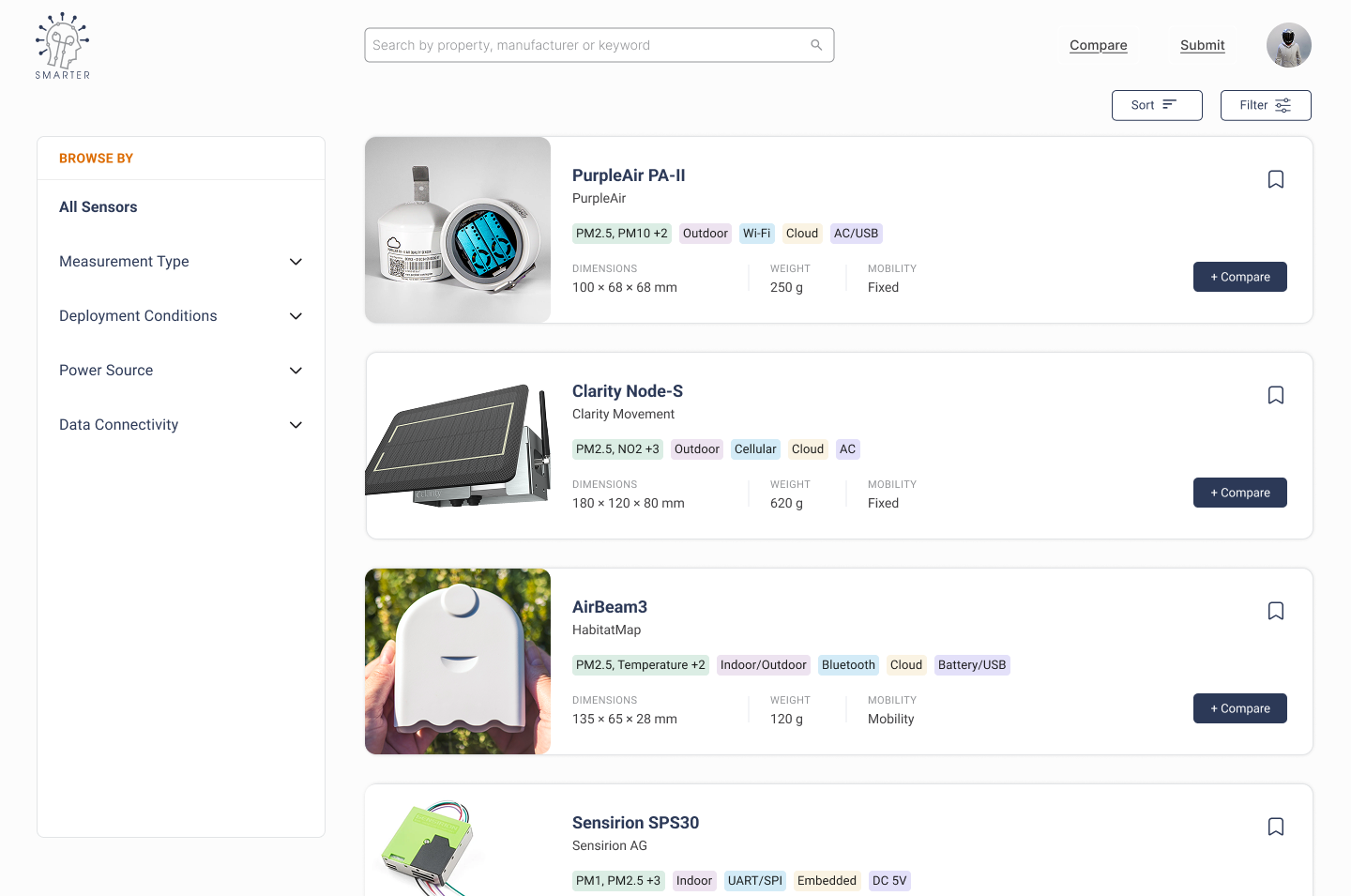
SMARTER Sensor Library Prototype, Home Page.
If you are able to contribute by participating in remote, user testing sessions where you would briefly test software designs or features, please let us know!
Sensor Common Metadata Specification (SCMS): Version 4.0 in Progress
The Sensor Common Metadata Specification (SCMS) provides a standardized framework for documenting sensor metadata across three core domains: Instrument, Deployment, and Output. The SCMS has now completed three full release cycles since its initial release in November 2024, each shaped by expert panel input, public comment, and findings from our research activities.
| Version | Release Date | Status |
|---|---|---|
| v1.0 | November 2024 | Released — initial expert panel review |
| v2.0 | April 2025 | Released — expert panel feedback incorporated |
| v3.0 | September 2025 | Released — further refinements |
| v4.0 | May 2026 (in progress) | In Progress — informed by LLM-augmented scoping review |
SCMS v4.0, targeted for release in May 2026, will introduce several important additions informed by the scoping review findings and researcher interview data:
Data security, including HIPAA compliance
Precision and bias documentation
Time lag
Deployment details (e.g., physical mounting)
Display control and data storage/overwrite rules
Calibration requirements and timestamp sources
Quick start guides to reduce the learning curve for new users
New Publications and Manuscripts
-
https://doi.org/10.1093/exposome/osag008
This newly published paper demonstrates the feasibility and scalability of using large language models (LLMs) to automate sensor metadata extraction from exposure health literature. Using GPT-4o in a zero-shot setting, the pipeline parses full-text PDFs and produces structured JSON output aligned with the SCMS. Key results:
229× faster than manual extraction (10.7 seconds vs. ~33 minutes per paper)
100% recall: all relevant metadata domains captured
95% precision and 97% F1-score
-
https://preprints.jmir.org/preprint/91311
This qualitative study—based on semi-structured interviews with six environmental health researchers analyzed using the HITREF framework—found that metadata is frequently insufficient, limiting data reuse and reproducibility. Researchers consistently desired tools that reduce burden rather than add to it. The study findings directly shaped the user requirements for the SMARTER Sensor Library.
-
This paper addresses a critical limitation of conventional exposure analysis: traditional daily averages and coarse summaries obscure the short-term spikes and episodic patterns—such as wildfire smoke events—that may be most relevant to health outcomes. The library provides over 64 million shapelets (32.2 million hourly, 32.4 million daily) extracted from U.S. EPA Air Quality System data spanning 2004–2024, covering 32 pollutant and meteorological categories. An interactive web interface supports filtering by pollutant, location, time period, and quality tier (https://ehie-shapelets.ctsi.utah.edu/). The library is already in use in four active research studies related to stillbirth, Hypersensitivity Pneumonitis, athlete performance, and suicide outcomes.
Recent Community Engagement: AQSS 2026
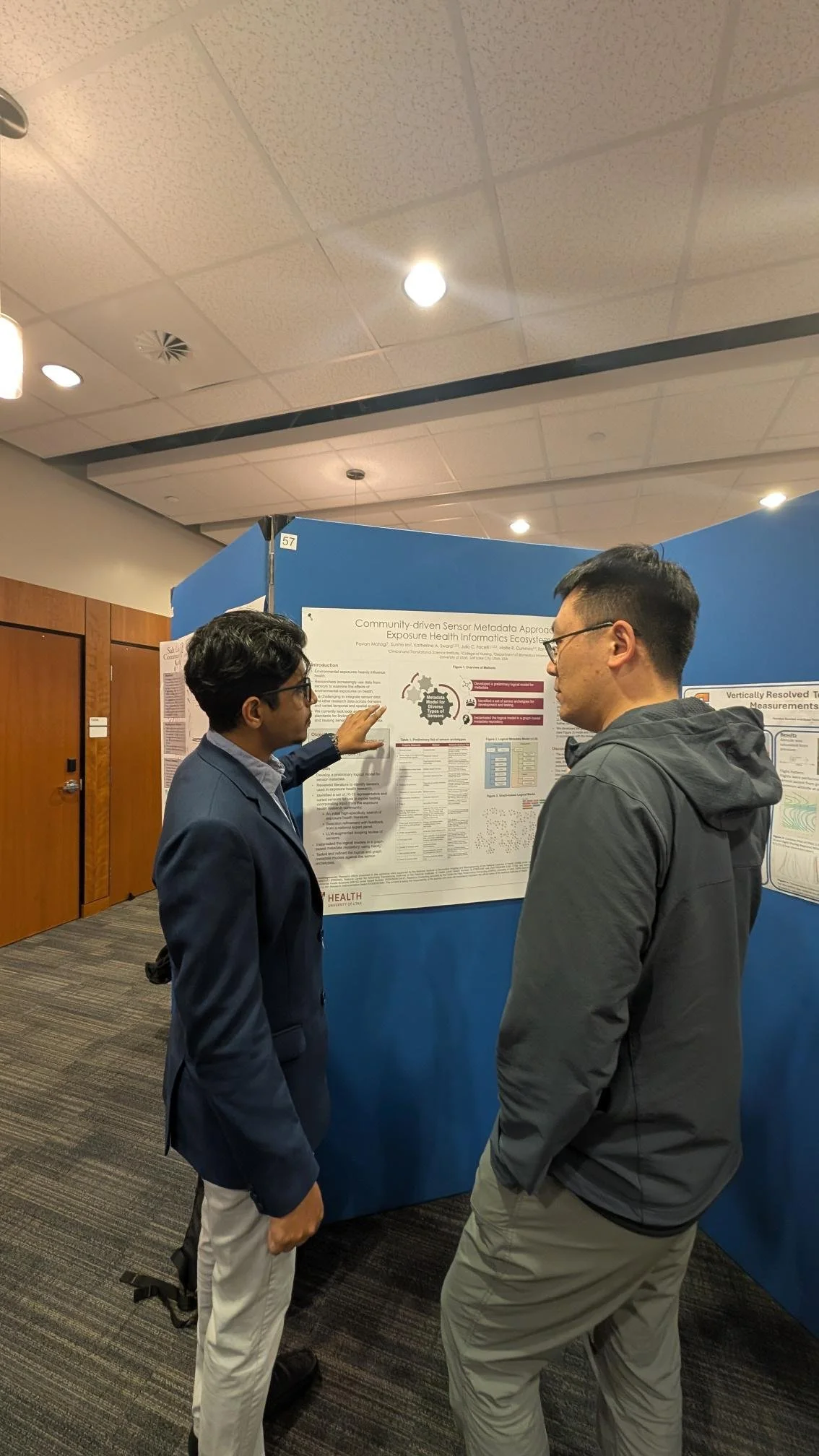
The SMARTER team participated in the Air Quality: Science for Solutions (AQSS) 2026 conference in Provo, Utah, with two poster presentations:
“Community-driven Sensor Metadata Approaches for Exposure Health Informatics Ecosystems.” Motagi, Im, Sward, Facelli, Cummins, Gouripeddi. Presented by Pavan Motagi.
This poster described the community-driven development of the SCMS through iterative expert panel review and the graph-based logical model and metadata repository.
“A Reusable U.S. Air Quality Shapelet Library for High Temporal Resolution Exposure Pattern Discovery.” Shishupal, Cummins, Sward, Bakian, Smart, Madsen, Varma, Stewart, Facelli, Gouripeddi. Presented by Sukrut Shishupal.
This poster described the creation of a freely available shapelet library for use in exposure health research studies.
Upcoming Presentations at Scientific Meetings
The SMARTER team will have a significant presence at two national conferences in May 2026. We invite colleagues to attend, connect at our booth, and provide input on the tools and resources we are developing.
Air Sensors International Conference (ASIC 2026), May 4–8, 2026 • Sheraton Gateway LAX, Los Angeles, CA
| Presentation | Presenter(s) | Date | Time | Location |
|---|---|---|---|---|
| Booth/Demo: SMARTER Sensor Library Website | Urvi Varma | May 4–7, 2026 | 8:00 AM – 5:00 PM | Grand Ballroom CD |
| Tutorial: “Sensors and Metadata for Analytics and Research in Exposure Health (SMARTER): Making Metadata FAIR” Session: Pre-conference Tutorial: Practical Guidance for Managing Sensor Data for Communities |
Mollie Cummins & Ram Gouripeddi | May 4, 2026 | 1:00 – 4:00 PM | Malibu & Redondo |
| Poster: Seeking Input from the Sensor Community for Development of a Metadata Store for Exposure Health | Urvi Varma | May 5, 2026 | 5:30 – 7:30 PM | Room TBD |
| Invited Talk: “Sensors and Metadata for Analytics and Research in Exposure Health (SMARTER): Making Metadata FAIR” Session: Data Standardization, Management, and Harmonization Session |
Mollie Cummins & Ram Gouripeddi | May 7, 2026 | 3:30 – 5:00 PM PDT | Malibu & Redondo |
AMIA Amplify Informatics Conference (AMIA 2026), May 18–21, 2026 • Grand Hyatt Denver, Denver, CO
| Presentation | Presenter(s) | Date | Time | Location |
|---|---|---|---|---|
| Workshop: Informatics Methods for Exposure Health | Gouripeddi, Shah-Mohammadi, Cummins, Sward, & Facelli | May 18, 2026 | 8:00 – 10:00 AM | Pikes Peak, 555 Building, 2nd Floor |
| Poster: Towards a Shapelet-Based Primitives Library for Exposure Health Machine Learning | Sukrut Shishupal | May 19, 2026 | 5:00 – 6:30 PM | Aspen Ballroom |
| Poster: NLP-Driven, Citation-Aware Automation of Sensor Metadata Extraction for Exposure Health Research | Fatemeh Shah-Mohammadi | May 19, 2026 | 5:00 – 6:30 PM | Aspen Ballroom |
| Poster: Reporting of Sensors in Environmental and Exposure Health Research: A Scoping Review | Sunho Im | May 20, 2026 | 5:00 – 6:30 PM | Aspen Ballroom |
| Poster: Designing and Evaluating a Sensor Library for Translational Exposure Health: A User-Centered Approach | Urvi Varma | May 20, 2026 | 5:00 – 6:30 PM | Aspen Ballroom |
Welcome to the Team: Dr. Naomi O. Riches
Dr. Naomi O. Riches, MSPH, PhD, Research Assistant Professor
We are delighted to welcome Dr. Naomi O. Riches, MSPH, PhD, Research Assistant Professor in the Department of Obstetrics & Gynecology at the University of Utah, to the SMARTER project.
Dr. Riches holds a doctorate in Occupational and Environmental Health and completed a postdoctoral fellowship in Biomedical Informatics at the University of Utah. Her research expertise spans environmental risk factors for adverse pregnancy and metabolic outcomes, including work on air pollution mixtures and stillbirth, and multipollutant cluster analysis of type 2 diabetes incidence.
Dr. Riches will contribute to Aim 4 of the SMARTER project, utilizing SMARTER and EHIE infrastructure in an exemplar study of air quality and birth outcomes. She will co-develop a series of workflow process diagrams and documentation to support researcher use of the SMARTER and EHIE ecosystem.
On the Horizon
Looking ahead to the remainder of 2026, the SMARTER team anticipates the following activities:
Release of SCMS v4.0 (May 2026)
Continued web development and user testing of the SMARTER Sensor Library
Increased focus on event modeling and metadata enrichment processes
Presentation at IEEE International Conference on Healthcare Informatics (ICHI 2026), Minneapolis, MN, June 1–3, 2026
Submissions planned for the International Society of Exposure Science (ISES) 2026 Annual Meeting, Vancouver, Canada, October 4–8, 2026 - see you there!
Ongoing expert panel engagement, community engagement and public comment processes
Stay Informed - Join our Mailing List!
Stay updated as we issue future updates and opportunities for public comment. Join our mailing list here.
The University of Utah SMARTER Project is funded by the National Institutes of Health, National Institute for Environmental Health Sciences (“Community-Driven Sensor Metadata Ecosystem for Exposure Health“, 1R24ES036134-01, Multi-Principal Investigators Ramkiran Gouripeddi & Mollie R. Cummins). The content of this web site is solely the responsibility of the authors and does not necessarily represent the official views of the University of Utah or the National Institutes of Health.